I Asked AI to Make a PlayStation 2 RPG
Why I picked the PS2, what the AI built, and the moment the experiment felt like a game.
On November 2, 2026, I opened a chat with a question.
What if I wanted to create the highest quality PS2 game in this day of 2026?
I picked the PlayStation 2 because making games for it was notoriously complicated. It had also been around long enough for people to write down years of hard-earned knowledge. I wanted to see how far an AI could get if I gave it the same hardware constraints and the benefit of everything people had published since. I was curious enough to let it try the whole thing.
I also had a practical reason for picking it. I already had a modified PS3 that could play PS2 discs. If the AI could package the project into a disc image, I had a way I hoped to try it. That made the experiment more tangible to me. I could ask for a game that was meant to run like a PS2 game, see the files it produced, and eventually try it with a controller and a television.
The kind of game I wanted
I remember finishing Knights of the Old Republic and thinking about the story after the credits. I liked that the companions had lives of their own. If they trusted you, you got to hear more of their stories. Who you took along could change what someone said to you. You could make your own character and get caught up in a mystery larger than anything you knew when you started. I wanted some of that feeling, with the darker tone I remember from the sequel.
The idea that came out of the conversation was The Last Signal. You arrive at a station that has been expecting you for nineteen years. The people there disagree about what you promised. You get to decide what to ask, who to trust, and what to do with the answers.
I gave Codex a goal to drive the project from early design all the way to a playable disc image. It would have to write the story, build the game, create the art and sound, and test what it made. I wanted the progress reports to leave the mystery intact for me.
That phrase, “drive the project,” turned into a twelve-phase brief in the same conversation. I asked for character creation, choices that mattered beyond the next line of dialogue, a crew with personal quests, and endings that followed from what the player had done. The AI would have to decide how to write and implement most of that. I set the constraints, looked at what came back, and stepped in when I could name a problem or a better reference. There was no fixed word count for the finished story. I eventually approved a shorter campaign so the work could go into making the existing game better.
One room first
The first development kit was called The Unclaimed Passenger. The whole build took place in one room. You could make a character, talk to people, pick up clues, earn or lose some trust, and deal with one sentry. There were two ways the little story could turn out. The characters looked like flat stand-ins, and the build had no sound. It already gave me the outline of what we were trying to build. A room could respond to the person you brought with you and the choice you had made a minute earlier.
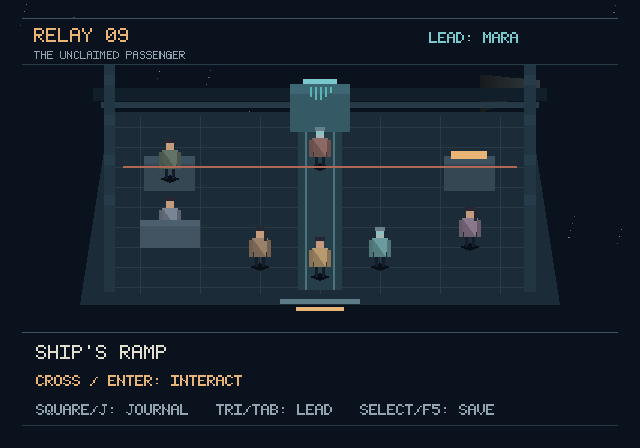
I like this screenshot because you can see the controls and the journal already in place. A few little figures are doing the work of an entire role-playing game. Instead of trying to write the whole campaign in one file and hoping it would work, the AI had a playable version of the loop to grow from. Later it added places, quests, equipment, companions to recruit, and a ship you could return to as the story changed.
The first time it felt real
The moment that got me was seeing the game launch in the emulator and watching the AI play and interact with it. An emulator is a program that lets a modern computer run software made for the old console. Seeing the title screen was exciting. Seeing the game respond to input was the part that stuck with me. The AI could walk up to someone, get a line back, and do something with it. That was the first time I felt like there was something here I might eventually sit down and play.
It also made me more particular. In one early picture, the interface always looked like it was explaining what button to press. I said it felt as if the game was permanently in tutorial mode. Later I saw a help screen with mouse and keyboard controls on it. The desktop version was useful while the game was being built, but I was imagining the experience from a couch with a PlayStation controller. That difference was easy to see once there was something to look at.
When version 1.0 sent us back to work
On November 4 there was a packaged version called 1.0 with a complete campaign, an ISO, a manual, and a record of what had been tested. It was a real checkpoint. It also showed me how far we still had to go visually. I remember asking why the models needed to be so low-detail when so many games I played on the same machine had done more.
I named Vice City and San Andreas, then brought up the PS2 Bond games and Scarface. I wasn’t asking for an open-world game. I was trying to describe how much detail and character I thought this platform could handle. We set a new goal around presentation and kept the story scope in place. When the AI came back with improvements, I wanted to see them in a game view where I could compare roughly the same thing.
The machine itself soon became part of the argument. It could draw an empty space quickly in an early test, then struggle as soon as the people were in it. The project needed to draw a regular room with moving characters, a camera, and menus while keeping the motion steady. That’s the point where I started asking it to study how PS2 developers had dealt with similar problems.
Trying another AI
GPT Astra drove the early work in Codex. On November 10 I asked Claude Fable 5.2 to look at the state of the project and tell me how it would finish it. A few messages later I asked, “What if I wanted you to complete this project? What if I wanted to see your direction and power to build this out?” I had been curious about Fable and wanted to see what it would do with an actual project.
I preferred what I was getting from Fable on this project, and it seemed to use my allowance more slowly. That’s what I saw switching between them. Astra’s early work was still underneath the game, and I later brought Codex back to review parts of what Fable did. Over time I found distinct jobs for the tools. One could carry the implementation forward while another read the project and asked whether the evidence backed up the claims.
The people started to look like people
After a series of new builds, I still wanted different characters. I asked the AI to use Blender, a 3D modeling and animation program. I even sent it a link to a local connection it could use to control Blender. I wanted it to build the whole cast, including townspeople, and make movement in Blender too. We agreed to try one character first so I could see what the process would produce.
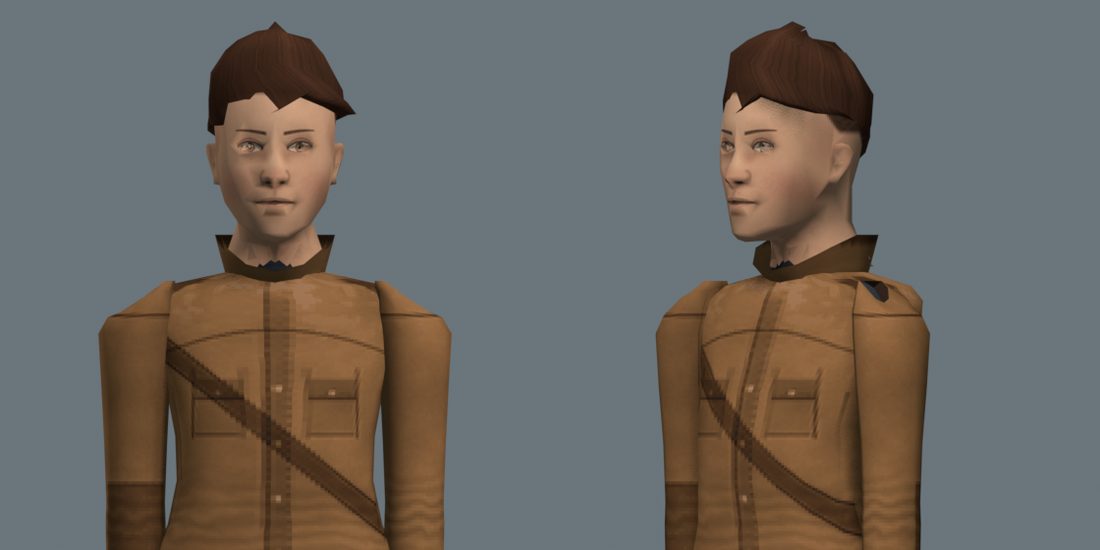
That first model was Mara. I asked where her hands were in an early render. The next versions gave me a better sense of how the character was taking shape, and I finally had feedback I could give in one sentence. “The only issue I have is that the eyes seem like they are in the skull on the left eye.” The AI adjusted it and applied the approach to the rest of the cast. Watching that happen in an art tool was one of the biggest surprises in the whole project.
The other surprise was hearing potential voices. The AI made two audition clips per companion using lines written for the audition, so I could listen without learning the story. Mara tells someone to strap in or stand clear. Ilex corrects the record halfway through a sentence. Tovan checks whether someone has eaten. You get a sense of three different people before you know a thing about the plot. I picked from the auditions and the project went on to put speech into the game.
Read the lines
“Strap in or stand clear. I am not paying for another seat cover.” “She flies better than she looks. Most days.” “We leave when the tide says so, not when you do.”
Why I’m still waiting to play
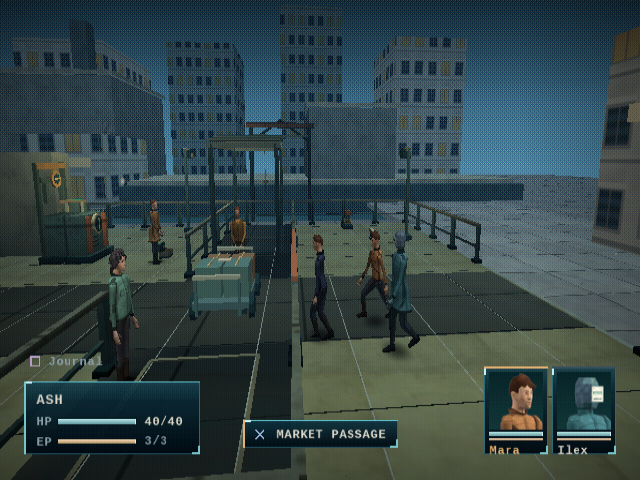
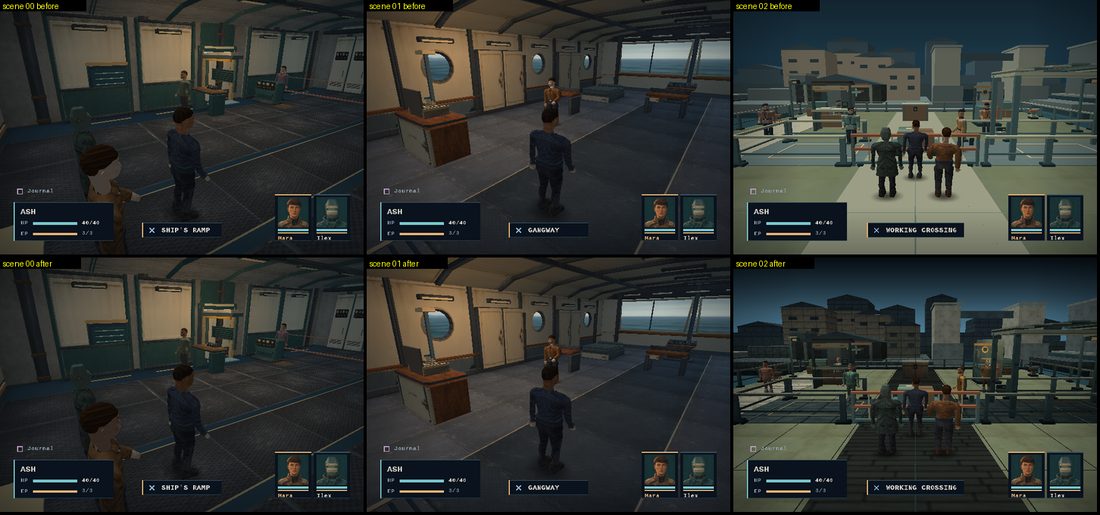
The distance between the two pictures below and the first room is a lot of the story for me. Later screens had a lower camera, room to see the party in the world, and surroundings that reached past the far wall. Even then, I’d sometimes see a bare floor or a room that felt as if it had been assembled five minutes before I got there. I knew what my eye would go to if I started playing at that point.
I wanted to get more specific about how the old games pulled it off. I offered Bully because I remembered how convincingly it sold a real place. We added Final Fantasy X and Final Fantasy XII, and I supplied the three discs as files for the AI to run in the emulator. I asked it to look at more than graphics. I wanted to know how those games staged conversations, how clearly they showed what was happening in a fight, and what made a space feel lived in.
The first result I could point to was a pool of light on the floor below a lamp. In Final Fantasy XII, a warm patch on a stone floor can tell your eye where to go. Putting one in The Last Signal gave the light a source I could see and gave the room a place to look. The reference study has more changes to work through. It gave us a way to talk about exactly what we wanted to see in the next build.
I’m still saving my first playthrough. I’ve seen the game boot, watched the AI take turns at the controls, and heard a version of Mara’s voice. I want my first encounter with the mystery to happen when I can settle in and just play.
The game is the first project I’m writing about here because it captures what got me interested in all of this. I didn’t know how much the AI would do after that first question. I certainly didn’t expect to be picking between voices for people it had written or asking it about a crooked eye in Blender. Those were the moments when I understood what I wanted to show friends who’d never used AI this way.
Continue with how the AI played and tested the game and what three retail PS2 games taught us.